
 Egi Sujana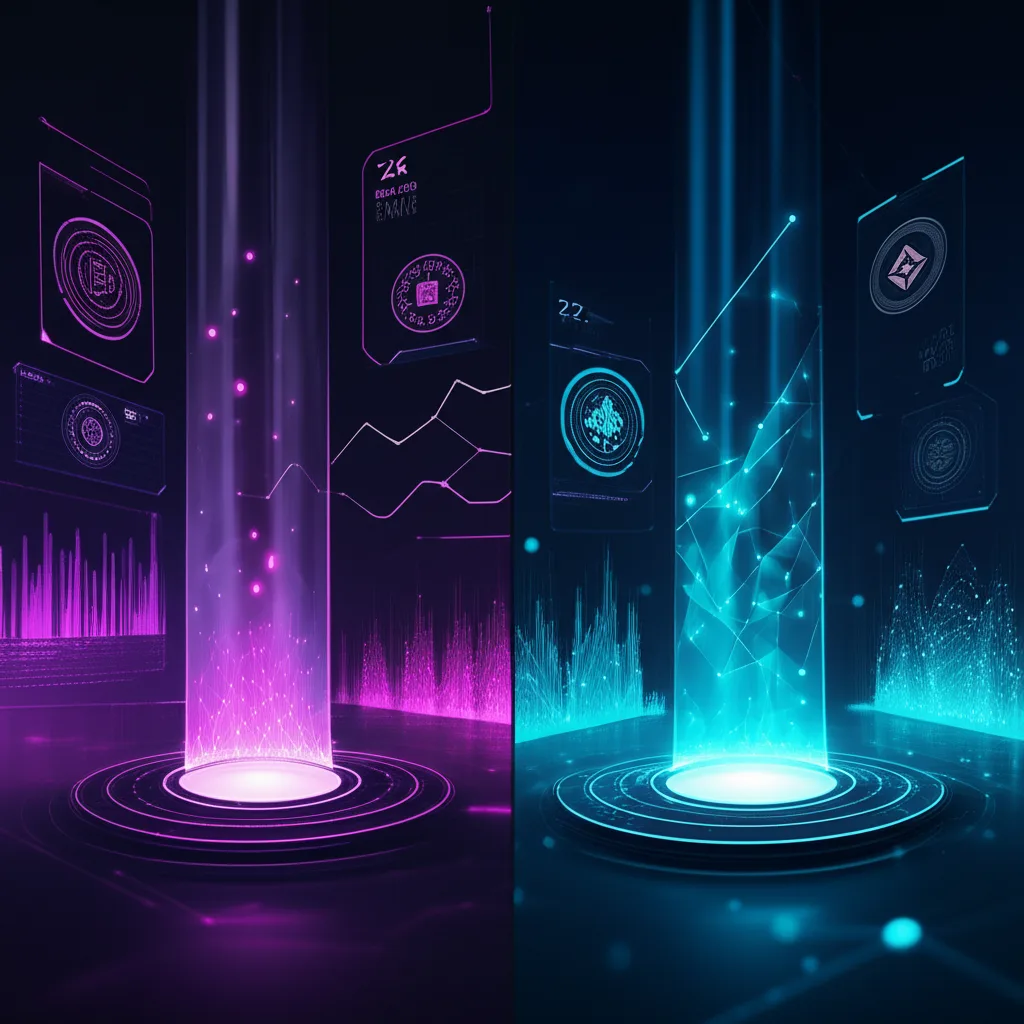
The quest for scalable, secure, and decentralized blockchain networks continues to be a core challenge in the crypto space, driving innovation in Layer 2 solutions. As we look towards 2025, the debate and development surrounding these scaling technologies have intensified, particularly concerning ZK Rollups Vs Optimistic Basics. This article will delve into the fundamental mechanisms, advantages, disadvantages, and projected landscape of these two prominent Layer 2 rollup types, offering a comprehensive understanding for anyone navigating the evolving Web3 ecosystem.
TL;DR
- ZK Rollups leverage cryptographic proofs (zero-knowledge proofs) to instantly verify the validity of transactions processed off-chain, offering superior security and immediate finality.
- Optimistic Rollups assume all off-chain transactions are valid by default, relying on a "challenge period" where anyone can submit a fraud proof to invalidate incorrect state transitions.
- Key Differences: ZK Rollups offer faster withdrawals and stronger security guarantees through mathematics, but are more complex to implement and historically less EVM-compatible. Optimistic Rollups are easier to build and highly EVM-compatible, but incur withdrawal delays due to the challenge period.
- By 2025: ZK Rollups are rapidly closing the EVM compatibility gap with advancements like zkEVMs, making them increasingly competitive for general-purpose dApps, while Optimistic Rollups continue to mature with enhanced fraud detection mechanisms.
- Both technologies are crucial for scaling blockchain networks like Ethereum, enabling higher transaction throughput and lower fees for digital assets and DeFi applications.
Understanding Layer 2 Scaling Solutions
The foundational blockchain networks, often referred to as Layer 1s (e.g., Ethereum), have revolutionized digital ownership and decentralized applications. However, their design, prioritizing decentralization and security, often leads to limitations in transaction throughput and higher fees during peak demand. This inherent scalability challenge has prompted the development of Layer 2 solutions, which operate on top of a Layer 1 blockchain to process transactions more efficiently while still inheriting the underlying security of the main chain.
Rollups are a leading category of Layer 2 scaling solutions. They bundle (or "roll up") hundreds or thousands of off-chain transactions into a single batch, which is then submitted to the Layer 1 chain. This significantly reduces the data load on the main chain, increasing transaction capacity and lowering costs. Within the rollup paradigm, ZK Rollups and Optimistic Rollups represent two distinct approaches to ensuring the validity of these off-chain transactions.
ZK Rollups: Zero-Knowledge Powerhouse
ZK Rollups derive their name from "Zero-Knowledge Proofs" (ZKPs), a cryptographic technique that allows one party to prove to another that a statement is true, without revealing any information beyond the validity of the statement itself. This mathematical rigor underpins their security model.
How ZK Rollups Work
- Off-chain Execution: Thousands of transactions are executed off the main blockchain on the ZK Rollup network.
- State Transition: The rollup operator updates the state of the rollup (e.g., account balances, smart contract states) based on these transactions.
- Proof Generation: After processing a batch of transactions and updating the state, the rollup operator generates a cryptographic proof (typically a SNARK or STARK) that cryptographically verifies the validity of all transactions in that batch and the resulting state transition. This proof is compact and computationally intensive to generate but extremely fast to verify.
- On-chain Submission: The new state root and the zero-knowledge proof are submitted to a smart contract on the Layer 1 blockchain.
- Proof Verification: The Layer 1 smart contract verifies the submitted proof. If the proof is valid, the new state root is accepted, and the transactions are considered finalized on Layer 1. This verification process is highly efficient and requires minimal computation on the main chain.
Advantages of ZK Rollups
- Instant Finality: Once the zero-knowledge proof is verified on Layer 1, the transactions are considered finalized. This means users can withdraw their digital assets or transfer tokens back to Layer 1 without any delay, a significant benefit for trading and DeFi.
- Enhanced Security: Security is cryptographically guaranteed by mathematical proofs. There’s no need to trust the rollup operator; the validity of transactions is proven. This robust security model makes them ideal for high-value transactions and critical infrastructure in Web3.
- Capital Efficiency: The immediate finality removes the need for challenge periods, freeing up capital that would otherwise be locked.
- Privacy Potential: While not inherent in all ZK Rollups, the underlying ZKP technology can be extended to build privacy-preserving applications, an increasingly important aspect of blockchain development by 2025.
Disadvantages of ZK Rollups
- Computational Complexity: Generating zero-knowledge proofs is computationally intensive, requiring specialized hardware or significant processing power from rollup operators.
- Higher Development Complexity: Building and deploying ZK Rollups is considerably more complex than Optimistic Rollups due to the intricate cryptography involved.
- Limited EVM Compatibility (Historically): Traditionally, making ZK Rollups fully compatible with the Ethereum Virtual Machine (EVM) has been a major hurdle. However, by 2025, significant progress has been made with the advent of zkEVMs (Zero-Knowledge EVMs), which aim to allow developers to deploy existing Solidity smart contracts directly onto ZK Rollups.
Optimistic Rollups: Assuming Honesty
Optimistic Rollups operate on an "optimistic" assumption: that all transactions processed off-chain are valid by default. This approach simplifies their design but introduces a different security mechanism involving fraud proofs and a challenge period.
How Optimistic Rollups Work
- Off-chain Execution: Similar to ZK Rollups, transactions are executed off-chain on the Optimistic Rollup network.
- State Transition: The rollup operator updates the state based on these transactions.
- On-chain Submission: The new state root and the compressed transaction data are submitted to the Layer 1 smart contract without immediate cryptographic proof of validity. The "optimistic" assumption means it’s considered valid unless proven otherwise.
- Challenge Period: A crucial component is the "challenge period" (typically 7 days, though variable). During this time, anyone observing the rollup’s state can submit a "fraud proof" to the Layer 1 smart contract if they detect an invalid state transition.
- Fraud Proof Verification: If a valid fraud proof is submitted, the Layer 1 smart contract executes the disputed transaction(s) using the provided data to determine if fraud occurred. If fraud is confirmed, the invalid state transition is reverted, and the malicious operator is penalized (e.g., by slashing their staked collateral). If no fraud proof is submitted within the challenge period, the transactions are considered finalized.
Advantages of Optimistic Rollups
- EVM Compatibility: Optimistic Rollups are generally easier to make EVM-compatible, meaning existing Ethereum dApps and smart contracts can be migrated with minimal changes. This has historically given them a head start in attracting developers and users.
- Lower Computational Overhead: Operators don’t need to generate complex cryptographic proofs, reducing the computational burden compared to ZK Rollups.
- Easier to Implement: The overall architecture is simpler, making them faster to develop and deploy.
Disadvantages of Optimistic Rollups
- Withdrawal Delays: The mandatory challenge period means that withdrawing funds or digital assets from an Optimistic Rollup back to Layer 1 can take several days (e.g., 7 days). This can be inconvenient for users and impact capital efficiency, especially for trading or urgent transfers.
- Security Relies on Active Monitoring: While robust, the security model relies on at least one honest participant actively monitoring the rollup and submitting fraud proofs if necessary. If no one monitors, a malicious operator could potentially commit fraud.
- Higher Capital Requirements for Challengers: To prevent frivolous challenges, participants who submit fraud proofs often need to stake collateral, which can be slashed if their challenge is found to be invalid.
ZK Rollups Vs Optimistic Basics 2025: A Comparative Analysis
By 2025, both ZK Rollups and Optimistic Rollups have matured significantly, addressing some of their initial limitations. The choice between them often depends on the specific requirements of the application, prioritizing factors like security, finality, and developer experience.
| Feature | ZK Rollups | Optimistic Rollups |
|---|---|---|
| Security Model | Cryptographic proofs (mathematically secure) | Fraud proofs (assumed valid, relies on monitoring) |
| Withdrawal Time | Near-instant (after L1 proof verification) | ~7 days (due to challenge period) |
| Transaction Finality | Immediate (on L1 verification) | Delayed (after challenge period expires) |
| EVM Compatibility | Historically challenging, rapidly improving with zkEVMs by 2025 | High (easy migration for dApps) |
| Computational Cost | High for proof generation (operator) | Low for operators |
| Development Complexity | High | Moderate |
| Use Cases | High-frequency trading, DeFi, privacy, critical infrastructure | General-purpose dApps, NFTs, gaming |
In 2025, the narrative around EVM compatibility for ZK Rollups has dramatically shifted. Projects like zkSync, Polygon zkEVM, and Scroll have made significant strides, offering nearly full or full EVM compatibility, bridging the gap that Optimistic Rollups historically enjoyed. This development is positioning ZK Rollups to be competitive across a much broader range of applications, including those previously dominated by Optimistic designs.
Optimistic Rollups, meanwhile, are exploring ways to mitigate withdrawal delays through third-party liquidity providers (e.g., "fast withdrawals") and by optimizing their challenge mechanisms. Both technologies are integral to the future of high-throughput blockchain transactions and the expansion of the Web3 economy.
Real-World Applications and Trends by 2025
The proliferation of Layer 2 solutions, including ZK Rollups and Optimistic Rollups, is fundamental to the continued growth and mainstream adoption of blockchain technology. By 2025, these scaling solutions are powering a vast array of digital assets, DeFi protocols, and Web3 applications.
Use Cases for ZK Rollups
With their instant finality and robust security, ZK Rollups are increasingly favored for:
- High-Frequency Trading & Exchanges: Enables rapid settlement of tokens and digital assets with minimal latency and strong security guarantees.
- DeFi Protocols Requiring Fast Finality: Lending, borrowing, and complex derivatives platforms benefit from immediate transaction finality, reducing counterparty risk.
- Privacy-Focused Applications: The underlying ZKP technology can be extended to create privacy-preserving transactions and smart contracts, crucial for enterprise blockchain and sensitive data management.
- Gaming: Fast, cheap transactions without withdrawal delays enhance the user experience for in-game economies and NFT transfers.
Use Cases for Optimistic Rollups
Leveraging their EVM compatibility and ease of deployment, Optimistic Rollups continue to be popular for:
- General-Purpose dApps: Applications that don’t require instant finality, such as social media platforms, content creation tools, and certain NFT marketplaces.
- Gaming and Metaverses: Where the occasional withdrawal delay is acceptable, but broad EVM compatibility for existing game logic and asset standards is paramount.
- New Protocol Incubation: Developers can quickly deploy and iterate on new DeFi or Web3 protocols, benefiting from lower gas fees and familiar development environments.
The trend by 2025 indicates a potential convergence in use cases as zkEVMs mature. However, the fundamental trade-offs between cryptographic security with higher complexity versus optimistic security with simpler implementation will likely ensure both approaches continue to thrive, catering to different market needs and risk profiles within the broader crypto landscape.
Risk Notes
Investing in or using cryptocurrencies, blockchain technology, and digital assets carries inherent risks. These include, but are not limited to, market volatility, smart contract vulnerabilities, regulatory changes, technological obsolescence, and potential loss of funds. While Layer 2 solutions aim to enhance security and scalability, they introduce new layers of complexity and potential points of failure. Always conduct thorough research and understand the risks involved before participating in any crypto-related activity.
Disclaimer
This article is for informational purposes only and does not constitute financial, investment, or legal advice. The content is based on publicly available information and general knowledge of blockchain technology and the crypto market as of 2025. You should consult with a qualified professional before making any financial decisions.
FAQ Section
Q1: Which rollup is "better" – ZK or Optimistic?
A1: There isn’t a single "better" rollup; it depends on the specific use case. ZK Rollups offer stronger cryptographic security and instant finality, making them ideal for high-value transactions and applications where immediate settlement is crucial. Optimistic Rollups, with their high EVM compatibility and simpler architecture, are often preferred for general-purpose dApps and where a short withdrawal delay is acceptable. By 2025, the gap in EVM compatibility for ZK Rollups has significantly narrowed, making the choice more about the security model and finality requirements.
Q2: What is the main difference in their security models?
A2: ZK Rollups rely on mathematical certainty; they use zero-knowledge proofs to cryptographically prove the validity of off-chain transactions to the Layer 1 chain. Optimistic Rollups, conversely, assume transactions are valid and rely on a "challenge period" where anyone can submit a "fraud proof" to dispute an invalid transaction. If no fraud is proven, the transaction is deemed valid.
Q3: Why do Optimistic Rollups have withdrawal delays?
A3: Optimistic Rollups have withdrawal delays (typically around 7 days) to allow sufficient time for any potential fraud to be detected and a fraud proof to be submitted to the Layer 1 chain. This "challenge period" is essential for their security model to function, ensuring that malicious operators cannot easily steal funds or manipulate the state.
Q4: How is EVM compatibility changing for ZK Rollups by 2025?
A4: By 2025, EVM compatibility for ZK Rollups has drastically improved. Projects developing zkEVMs (Zero-Knowledge EVMs) are enabling developers to deploy existing Solidity smart contracts directly onto ZK Rollups with minimal or no modifications. This crucial advancement makes ZK Rollups much more accessible and competitive for a broader range of dApps that traditionally favored Optimistic Rollups.
Q5: Will Layer 2 solutions replace Layer 1s like Ethereum?
A5: No, Layer 2 solutions like ZK Rollups and Optimistic Rollups are designed to complement and scale Layer 1 blockchains, not replace them. They inherit their security from the underlying Layer 1, leveraging its decentralization and robust consensus mechanisms. Layer 2s handle transaction throughput, while Layer 1s provide the foundational security and data availability guarantees.
Q6: What’s the role of sequencers in rollups?
A6: Sequencers are nodes responsible for collecting, ordering, and batching transactions on a rollup. They propose new blocks, execute transactions, and submit the state updates (along with proofs for ZK Rollups or just data for Optimistic Rollups) to the Layer 1 chain. While often centralized initially for efficiency, there’s a strong trend by 2025 towards decentralizing sequencers to enhance censorship resistance and reduce single points of failure.
Conclusion
The evolution of Layer 2 scaling solutions is a testament to the dynamic innovation within the blockchain space, striving to overcome the inherent limitations of Layer 1 networks. Both ZK Rollups and Optimistic Rollups offer compelling pathways to increased transaction throughput and reduced fees, fundamentally shaping how we interact with digital assets and Web3 applications. While Optimistic Rollups initially led in EVM compatibility and ease of deployment, the rapid advancements in zkEVM technology by 2025 have positioned ZK Rollups as a formidable contender for virtually all use cases, offering superior security and instant finality.
Understanding the nuances of ZK Rollups Vs Optimistic Basics 2025 is critical for developers, investors, and users navigating the ever-expanding crypto landscape. As these technologies continue to mature and converge in their capabilities, they collectively pave the way for a more scalable, efficient, and accessible decentralized future. The choice between them will increasingly hinge on specific application requirements, balancing the trade-offs between cryptographic certainty, withdrawal times, and development complexity, ultimately benefiting the entire ecosystem with diverse and robust scaling solutions.





 Rifan Muazin
 Gus Nur
 Dokter Tifa