
 Rismon Sianipar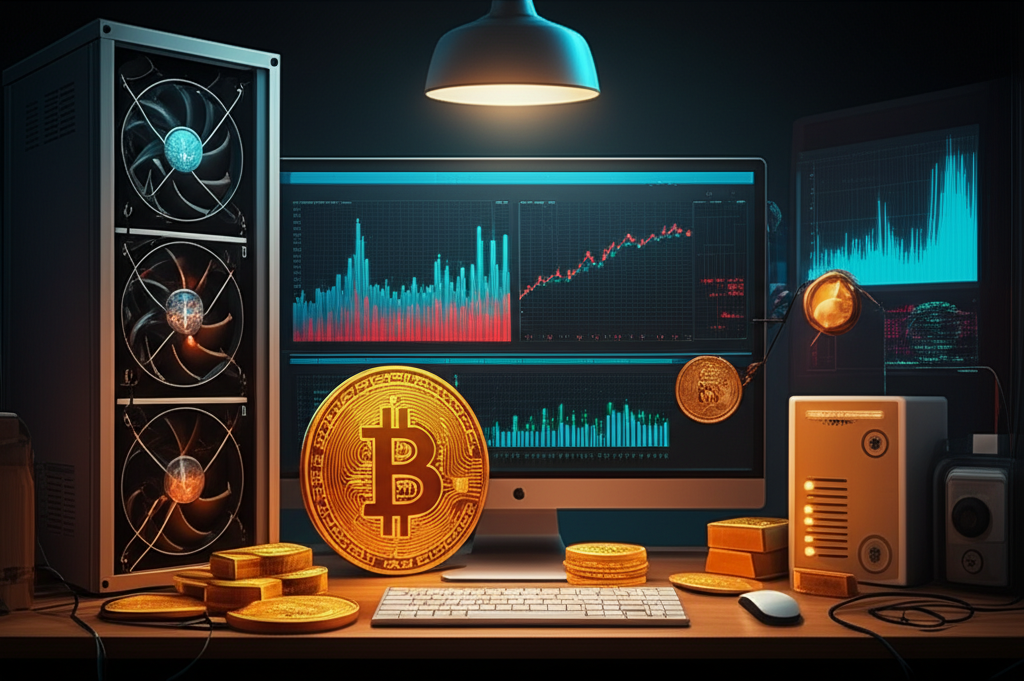
The age-old debate of Bitcoin vs Gold continues to captivate investors seeking stable stores of value and potential passive income streams. With the rise of decentralized finance (DeFi) and increasingly accessible technology, the prospect of Bitcoin mining at home for passive income in 2025 is a compelling, albeit complex, consideration. This article explores the pros and cons of both Bitcoin and Gold, delves into the feasibility of home Bitcoin mining, and provides a realistic outlook for generating passive income through this digital asset.
TL;DR:
- Bitcoin vs Gold: Both offer potential as stores of value, but Bitcoin is more volatile.
- Home Bitcoin Mining: Technically possible, but profitability depends heavily on electricity costs and mining hardware.
- Passive Income Potential: Exists, but requires significant upfront investment and ongoing maintenance.
- 2025 Outlook: Mining difficulty will likely increase, requiring more powerful hardware to remain competitive.
- Risks: High electricity costs, hardware depreciation, regulatory changes, and Bitcoin price fluctuations.
- Alternative: Consider other passive crypto income strategies like staking or yield farming.
Bitcoin vs. Gold: A Modern Store of Value
For centuries, gold has been the go-to hedge against economic uncertainty. Its scarcity and inherent value have made it a reliable store of wealth. However, in the digital age, Bitcoin has emerged as a potential alternative, often referred to as "digital gold." Let’s examine the key differences:
- Scarcity: Gold is finite, but its exact quantity is unknown. Bitcoin has a hard cap of 21 million coins, making it demonstrably scarce.
- Divisibility: Gold is divisible, but Bitcoin can be divided into satoshis (0.00000001 BTC), making it far more divisible.
- Portability: Gold is physical and can be cumbersome to transport. Bitcoin is digital and can be transferred globally almost instantly.
- Acceptance: Gold has widespread acceptance globally. Bitcoin’s acceptance is growing but still faces regulatory hurdles and varying levels of adoption.
- Volatility: Gold is relatively stable compared to Bitcoin, which is known for its significant price swings. This volatility can be both an opportunity and a risk.
While gold boasts a long track record of stability, Bitcoin offers advantages in divisibility and portability. The choice between the two depends on individual risk tolerance and investment goals. As we move towards 2025, the landscape of digital assets continues to evolve, bringing new opportunities and challenges.
Understanding Bitcoin Mining and the Blockchain
Bitcoin mining is the process of verifying and adding new transaction data to the Bitcoin blockchain. Miners use specialized hardware to solve complex cryptographic puzzles. The first miner to solve the puzzle gets to add the next block to the chain and is rewarded with newly minted Bitcoin and transaction fees. This process secures the network and ensures the integrity of the blockchain.
The difficulty of these cryptographic puzzles adjusts automatically to maintain a consistent block creation time of approximately 10 minutes. As more miners join the network, the difficulty increases, requiring more computational power to solve the puzzles. This increased difficulty is a crucial factor to consider when assessing the feasibility of Bitcoin mining at home in 2025.
The Bitcoin network operates on a Proof-of-Work (PoW) consensus mechanism. This means that miners must expend significant energy to prove they have done the work required to validate transactions. This energy expenditure is a key criticism of Bitcoin mining, but also a crucial element in its security.
Is Bitcoin Mining at Home for Passive Income Realistic?
The allure of earning passive income by mining Bitcoin from the comfort of your home is understandable. However, the reality is more complex than simply plugging in a mining rig and watching the Bitcoin roll in. Here’s a breakdown of the key considerations:
- Hardware Costs: Bitcoin mining requires specialized hardware known as ASICs (Application-Specific Integrated Circuits). These machines are expensive, ranging from a few thousand to tens of thousands of dollars, and become obsolete relatively quickly as newer, more efficient models are released.
- Electricity Costs: Mining consumes a significant amount of electricity. The profitability of home mining hinges on access to cheap electricity. High electricity bills can quickly negate any potential profits.
- Mining Difficulty: As mentioned earlier, mining difficulty adjusts based on the total hashing power of the network. As more miners compete, the difficulty increases, making it harder for individual miners to earn rewards. By 2025, the mining difficulty is projected to be significantly higher than it is today.
- Pool Mining: Most individual miners join mining pools, which combine their computational power to increase their chances of solving blocks. Pool members share the rewards proportionally to their contribution.
- Maintenance and Cooling: Mining hardware generates a lot of heat and requires proper ventilation and cooling. Regular maintenance is also necessary to keep the equipment running efficiently.
- Noise: ASIC miners are notoriously noisy, which can be disruptive in a home environment.
Example:
Let’s say you invest $5,000 in a mining rig that consumes 1,500 watts. Your electricity costs are $0.10 per kWh. The current Bitcoin mining difficulty and price might suggest a potential profit of $10 per day. However, factor in depreciation of the hardware, potential downtime, and fluctuations in Bitcoin price, and your actual profit could be significantly lower, or even negative.
Alternatives to Home Mining:
If home mining seems too daunting, consider these alternatives for earning passive crypto income:
- Cloud Mining: Renting mining power from a third-party provider. This eliminates the need to purchase and maintain hardware, but comes with its own set of risks (e.g., scam providers).
- Staking: Holding and "staking" certain cryptocurrencies to earn rewards for validating transactions on a Proof-of-Stake (PoS) blockchain.
- Yield Farming: Providing liquidity to DeFi protocols and earning rewards in the form of tokens.
- Trading Bots: Using automated trading bots to execute trades based on pre-defined parameters.
Key Factors Influencing Home Mining Profitability in 2025
Several factors will play a crucial role in determining the profitability of Bitcoin mining at home in 2025:
- Bitcoin Price: The price of Bitcoin is the most significant factor. A higher price translates to higher mining rewards.
- Electricity Costs: Access to cheap electricity is essential. Consider renewable energy sources like solar power to reduce costs.
- Hardware Efficiency: Investing in the most efficient mining hardware is crucial. Look for machines with a high hash rate and low power consumption.
- Mining Pool Fees: Different mining pools charge different fees. Shop around for the best rates.
- Regulatory Environment: Government regulations regarding cryptocurrency mining can significantly impact profitability. Stay informed about the latest developments in your region.
- Advancements in Mining Technology: New advancements in mining technology could render existing hardware obsolete more quickly.
Risks Associated with Bitcoin Mining
Bitcoin mining is not without its risks. It’s important to be aware of these before investing:
- Hardware Depreciation: Mining hardware depreciates rapidly. As newer, more efficient models are released, older models become less profitable.
- Bitcoin Price Volatility: The price of Bitcoin can fluctuate significantly, impacting mining profitability.
- Increased Mining Difficulty: As more miners join the network, the mining difficulty increases, making it harder to earn rewards.
- Regulatory Risks: Governments could introduce regulations that make Bitcoin mining more difficult or even illegal.
- Scam Mining Pools: Some mining pools are scams that will steal your earnings. Do your research before joining a pool.
- Security Risks: Mining hardware can be vulnerable to hacking and malware. Protect your equipment with strong passwords and security software.
FAQ: Bitcoin Mining at Home in 2025
- Q: Is it still profitable to mine Bitcoin at home in 2025?
- A: It depends on several factors, including electricity costs, hardware efficiency, and Bitcoin price. Profitability is not guaranteed and requires careful planning and analysis.
- Q: What is the best mining hardware for home mining in 2025?
- A: The best hardware will depend on your budget and electricity costs. Research the latest ASIC miners and compare their hash rates, power consumption, and prices.
- Q: How much electricity does Bitcoin mining consume?
- A: Bitcoin mining can consume a significant amount of electricity. The exact amount will depend on the hardware you use, but it’s important to factor this into your cost calculations.
- Q: What are the alternatives to Bitcoin mining for earning passive crypto income?
- A: Alternatives include staking, yield farming, cloud mining, and using trading bots.
- Q: What are the regulatory risks associated with Bitcoin mining?
- A: Governments could introduce regulations that make Bitcoin mining more difficult or even illegal. Stay informed about the latest developments in your region.
- Q: How do I choose a reputable mining pool?
- A: Research mining pools carefully. Look for pools with a long track record, transparent fees, and good security measures.
Disclaimer: This article is for informational purposes only and does not constitute financial advice. Cryptocurrency investments are highly speculative and carry significant risk. Always do your own research before investing in any cryptocurrency.
Conclusion: Evaluating Bitcoin vs Gold and the Future of Home Mining
The decision between Bitcoin vs Gold as a store of value remains a personal one, dependent on individual risk tolerance and investment strategy. While gold offers stability, Bitcoin presents the potential for higher returns but with increased volatility. The viability of Bitcoin mining at home for passive income in hinges on a complex interplay of factors, including access to cheap electricity, efficient hardware, and favorable regulatory conditions. While the dream of effortless passive income through mining may be alluring, a realistic assessment of the costs, risks, and evolving landscape of the crypto world is crucial. Consider exploring alternative passive income strategies within the DeFi space and always prioritize thorough research and due diligence before investing in any digital assets. The future of crypto is dynamic, and informed decision-making is key to navigating this exciting, yet challenging, terrain.



 Roy Suryo

 Dokter Tifa

 Egi Sujana