 Egi Sujana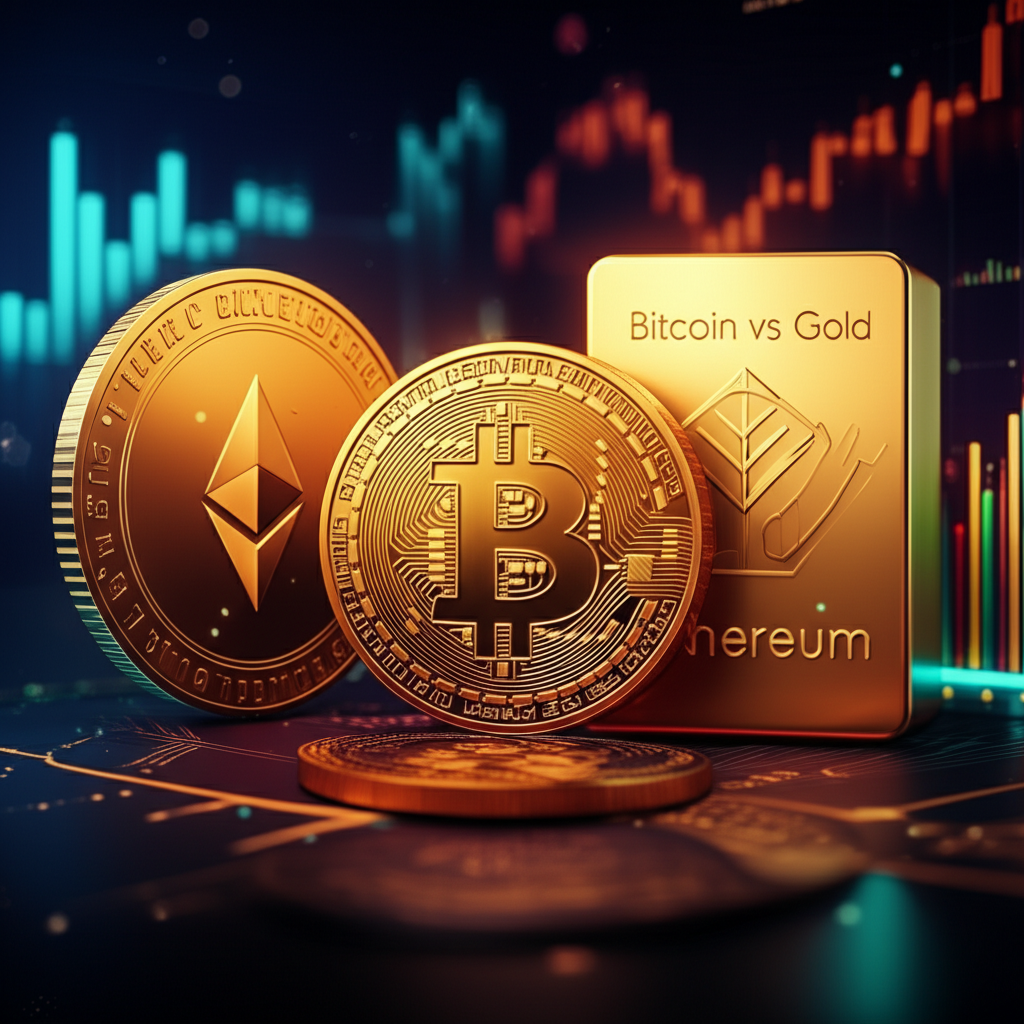
The investment landscape is constantly evolving, with traditional assets like gold contending with the disruptive force of digital assets like Bitcoin and Ethereum. As we look towards 2025, investors are increasingly scrutinizing where to allocate capital for optimal returns and long-term security. This article delves into a comprehensive comparison of Bitcoin and Gold as stores of value, and critically examines whether Ethereum staking presents a compelling investment opportunity in the coming year. We’ll explore the unique characteristics, risks, and potential rewards of each, helping you navigate the complexities of this modern financial frontier.
TL;DR
- Bitcoin: A digital gold narrative, offering decentralization and scarcity, but comes with high volatility and regulatory uncertainty. Potential for significant appreciation by 2025 but also substantial risk.
- Gold: A traditional safe haven, offering stability and a hedge against inflation. Lower volatility and established market, but typically offers modest returns and has storage costs.
- Ethereum Staking: Provides passive income (rewards) by securing the Ethereum blockchain. Offers potential for capital appreciation of ETH tokens and participation in the Web3 ecosystem. By 2025, expected to be more mature post-merge, but still carries risks like smart contract vulnerabilities, illiquidity, and price volatility.
- Is it Worth It in 2025?: For investors seeking yield and exposure to cutting-edge blockchain technology, Ethereum staking could be compelling. However, its suitability depends on risk tolerance, investment goals, and the continued development and regulatory clarity of the crypto market. It’s not a risk-free investment.
The Enduring Allure of Gold: A Traditional Safe Haven
Gold has been a store of value for millennia, revered for its scarcity, tangibility, and historical role as a hedge against economic uncertainty and inflation. It’s a physical asset that has maintained its purchasing power through countless financial crises, making it a cornerstone of many diversified portfolios.
Why Investors Turn to Gold
- Inflation Hedge: When fiat currencies lose value, gold traditionally holds its own, preserving wealth.
- Safe Haven Asset: During geopolitical instability or economic downturns, gold often sees increased demand as investors seek refuge from riskier assets.
- Tangibility: Unlike digital assets, gold is a physical commodity that can be held, offering a sense of security to many investors.
- Low Volatility: Compared to cryptocurrencies, gold’s price movements are generally more stable, appealing to risk-averse investors.
Gold’s Drawbacks
Despite its benefits, gold also has its limitations. It doesn’t generate income or dividends, and its returns have historically been modest compared to growth assets. Storage and insurance can incur costs, and its price can be influenced by factors like interest rates and the strength of the U.S. dollar.
Bitcoin: The Rise of Digital Gold
Emerging from the 2008 financial crisis, Bitcoin was designed as a decentralized, peer-to-peer digital currency, free from government control and traditional financial institutions. Its fixed supply of 21 million tokens and cryptographic security have led many to label it "digital gold."
Bitcoin’s Value Proposition
- Scarcity: With a hard cap on its supply, Bitcoin mimics gold’s scarcity, driving its value proposition.
- Decentralization: No single entity controls Bitcoin, making it resistant to censorship and manipulation, a core principle of blockchain technology.
- Portability & Divisibility: Easily transferred across borders and divisible into small units, unlike physical gold.
- Deflationary Asset: Its fixed supply and halving events make it inherently deflationary, a potential hedge against inflation in the digital age.
- Growing Adoption: Increasing institutional interest, payment integrations, and recognition as a legitimate asset class contribute to its long-term potential.
Risks Associated with Bitcoin
Bitcoin’s journey has been marked by extreme price volatility, making it a high-risk, high-reward investment. Regulatory uncertainty across different jurisdictions poses a significant challenge. Furthermore, its energy consumption, though evolving, remains a point of contention. Security risks, while mitigated by robust cryptographic measures, still exist in terms of exchange hacks or user error.
Bitcoin vs Gold: Is Ethereum Staking Worth It in 2025?
This section dives into the core comparison and the viability of Ethereum staking.
Comparing Bitcoin and Gold
| Feature | Gold | Bitcoin |
|---|---|---|
| Nature | Physical commodity | Digital asset (cryptocurrency) |
| Scarcity | Limited geological supply | Hard-capped 21 million tokens |
| Decentralization | None (centralized markets) | Fully decentralized (blockchain) |
| Volatility | Low to moderate | High |
| Inflation Hedge | Proven historical record | Potential, but unproven over long term |
| Yield/Income | None | None (unless lent out via DeFi) |
| Storage | Physical storage/vaults (costs) | Digital wallets (user responsibility) |
| Regulation | Well-established | Evolving, highly uncertain |
| Market Cap | Trillions of dollars | Over $1 Trillion (highly variable) |
For investors prioritizing stability and a proven track record, gold remains a strong contender. For those with a higher risk tolerance seeking potentially explosive growth and exposure to the digital frontier, Bitcoin offers a compelling, albeit volatile, alternative. The decision often boils down to an individual’s investment philosophy and risk appetite.
Understanding Ethereum Staking for 2025
Ethereum, the second-largest cryptocurrency by market capitalization, transitioned from a Proof-of-Work (PoW) consensus mechanism to Proof-of-Stake (PoS) with "The Merge" in late 2022. This fundamental shift introduced "staking," allowing ETH holders to earn rewards by locking up their tokens to secure the network.
What is Ethereum Staking?
Staking involves committing your ETH tokens to a validator to help process transactions and maintain the security of the Ethereum blockchain. In return for contributing to the network’s integrity, stakers receive newly minted ETH tokens as rewards. This mechanism is central to the efficiency and security of the Web3 ecosystem.
Why 2025 is a Key Year for Ethereum Staking
By 2025, Ethereum’s PoS mechanism is expected to be more mature and stable. Further upgrades like "Dencun" (EIP-4844) and future "Surge" developments aiming for greater scalability (sharding) are anticipated to enhance the network’s performance and potentially increase the value proposition of ETH. Increased institutional adoption of DeFi and clearer regulatory frameworks could also bolster confidence in staking.
The "Worth It" Equation: Pros of Ethereum Staking
- Passive Income: Staking provides a regular yield in ETH, effectively earning interest on your holdings. This income stream can be a significant draw for long-term investors.
- Network Participation: Stakers contribute directly to the security and decentralization of one of the most important blockchain networks, a core pillar of Web3.
- Potential for Capital Appreciation: Beyond staking rewards, stakers benefit if the price of ETH tokens increases over time, offering a dual potential for returns.
- Environmental Friendliness: PoS is significantly more energy-efficient than PoW, aligning with growing ESG (Environmental, Social, Governance) investment trends.
The Risks and Cons of Ethereum Staking
While attractive, Ethereum staking is not without its risks:
- Illiquidity/Lock-up Periods: Staked ETH is typically locked up and cannot be easily accessed or sold immediately. While withdrawals are enabled post-Shanghai upgrade, there might still be queues or delays, especially if staking through a service.
- Price Volatility: The value of ETH tokens can fluctuate wildly. Even with staking rewards, a significant drop in ETH’s price could wipe out or exceed staking gains.
- Smart Contract Risk: If you use a staking pool or liquid staking derivative, you are exposed to the smart contract risk of those platforms. Bugs or exploits could lead to loss of funds.
- Validator Risk (for solo stakers): Solo stakers (requiring 32 ETH) face the risk of "slashing" – penalties for downtime or malicious behavior, leading to loss of staked ETH.
- Regulatory Uncertainty: The classification of staked assets and staking rewards by tax authorities and regulators is still evolving, potentially impacting tax obligations.
- Opportunity Cost: Staked ETH cannot be used for other investment opportunities (e.g., trading, lending in other DeFi protocols) during the lock-up period.
Navigating the Investment Landscape: Strategic Considerations for 2025
Deciding between Gold, Bitcoin, or Ethereum staking in 2025 depends heavily on your individual investment goals, risk tolerance, and time horizon.
- For Capital Preservation and Stability: Gold remains the most reliable option for hedging against inflation and market volatility, albeit with lower growth potential.
- For High Growth Potential and Digital Exposure: Bitcoin offers significant upside potential, riding on its "digital gold" narrative and increasing adoption, but demands a high tolerance for volatility.
- For Yield and Blockchain Innovation: Ethereum staking provides a unique blend of passive income and exposure to the cutting edge of blockchain technology and the growing DeFi ecosystem. It’s a way to earn yield on a digital asset that is foundational to Web3.
Diversification is key. Many investors choose to allocate a portion of their portfolio to each asset class, balancing the stability of gold with the growth potential of digital assets. For those specifically interested in the crypto space, combining direct ETH holdings with ETH staking can offer a balanced approach to participation and income generation.
Risk Note:
All investments, especially those in volatile markets like cryptocurrency, carry inherent risks. The value of your investments can go down as well as up, and you may lose some or all of your invested capital. Past performance is not indicative of future results.
Disclaimer:
This article is for informational purposes only and should not be considered financial advice. Before making any investment decisions, consult with a qualified financial professional. Conduct thorough research and understand the risks involved.
FAQ Section
1. Is Bitcoin a better inflation hedge than gold?
While Bitcoin’s fixed supply is theoretically deflationary, its short history and high volatility make it unproven as a reliable long-term inflation hedge compared to gold’s millennia-long track record. Gold has historically performed well during inflationary periods, whereas Bitcoin’s performance is more tied to broader crypto market sentiment and adoption.
2. What are the main risks of Ethereum staking in 2025?
Key risks include the price volatility of ETH tokens, potential illiquidity of staked assets (though improved post-Shanghai upgrade), smart contract vulnerabilities if using staking pools, slashing penalties for validators, and evolving regulatory and tax implications.
3. How does Ethereum staking compare to simply holding ETH?
Holding ETH allows for immediate liquidity and flexibility to sell or use your tokens. Staking ETH, however, provides passive income through rewards, effectively increasing your ETH holdings over time. The trade-off is the lock-up period and associated risks. For long-term holders, staking can be a way to maximize returns on their ETH.
4. What is the outlook for crypto regulation in 2025?
By 2025, it’s anticipated that major economies will have made further progress in developing clearer regulatory frameworks for digital assets, including cryptocurrencies and staking. This could bring both increased certainty and potential compliance costs, but ultimately foster greater institutional adoption and market maturity.
5. Can Ethereum staking provide a reliable income stream?
While Ethereum staking offers passive income, its reliability as a primary income stream is tied to the volatile price of ETH. The actual fiat value of staking rewards can fluctuate significantly. It’s best viewed as a way to grow your ETH holdings or supplement income, rather than a guaranteed stable source of living expenses.
6. What are liquid staking tokens, and are they safer?
Liquid staking tokens (LSTs) like Lido’s stETH or Rocket Pool’s rETH allow users to stake ETH and receive a tokenized representation of their staked ETH plus rewards. This provides liquidity, as LSTs can be traded or used in other DeFi protocols. While they solve the illiquidity problem, they introduce additional smart contract risk associated with the LST protocol itself.
Conclusion
The debate between Bitcoin vs Gold: Is Ethereum Staking Worth It in 2025? underscores a fundamental shift in how investors perceive value and opportunity. Gold offers time-tested stability and a hedge against uncertainty. Bitcoin provides a high-growth, high-risk play on the future of decentralized finance. Ethereum staking, on the other hand, offers a compelling blend of passive income and active participation in the evolving Web3 economy.
For 2025, the "worth it" of Ethereum staking largely depends on an investor’s appetite for risk, their long-term conviction in the Ethereum network, and their desire for yield in the digital asset space. While staking promises rewards and contributes to network security, the inherent volatility of ETH, smart contract risks, and evolving regulatory landscape demand careful consideration. A diversified approach, balancing traditional assets with strategic exposure to innovative digital assets like staked Ethereum, may be the most prudent path for navigating the complex financial terrain ahead.

 Roy Suryo
 Rismon Sianipar
 Dokter Tifa